Learning Robot Policies for Whole-Body Mobility Assistance
via Dynamic Human Motion Generation

Shikun Ban1,*, Shohei Nagai1,*, Qingyang Song2, Hanxi Wan2, Eric Zhao2, Thomas Wang2, Zackory Erickson1

1The Robotics Institute, School of Computer Science,
Carnegie Mellon University

2Intuitive Autonomy

*Equal contribution. These authors are listed in alphabetical order.

Abstract

Robotic assistance for human mobility could benefit care recipients and reduce caregiver burden during physically demanding tasks such as Sit-to-Stand (STS) and Lift-and-Transfer (L&T). Learning robot policies for these whole-body assistive tasks is challenging: real-world data collection for human-robot interaction is costly and safety-critical, making simulation an attractive alternative. Prior work, however, typically treats the human as static or minimally responsive and thus fails to capture the cooperative nature of mobility assistance. We present a simulation-based framework for learning whole-body assistive robot policies. At its core is a human policy trained with an adversarial motion prior that produces realistic care-recipient motion in response to the robot's actions. A human-adaptive scripted controller interacts with this policy to collect diverse robot demonstrations at scale. From these demonstrations, we train 3D diffusion policies that map segmented human point clouds and robot joint positions to whole-body actions for a mobile manipulator, without relying on privileged human state at deployment. The resulting robot policies successfully perform both STS and L&T assistance in simulation. Preliminary experiments further demonstrate sim-to-real transfer for STS after fine-tuning on a small amount of real-world data.

Overview


Our training framework has three stages. First, we train a physics-based human policy with an Adversarial Motion Prior (AMP) and latent conditioning to generate dynamic physics-based human motions across varied human physical capabilities, body scales, poses, motion styles, and environments. Next, we simulate robot assistance with a human-adaptive scripted controller and curate successful interactions as robot demonstrations. Finally, we train a deployable assistive robot policy that maps segmented human point clouds and robot joint positions to robot delta joint actions.
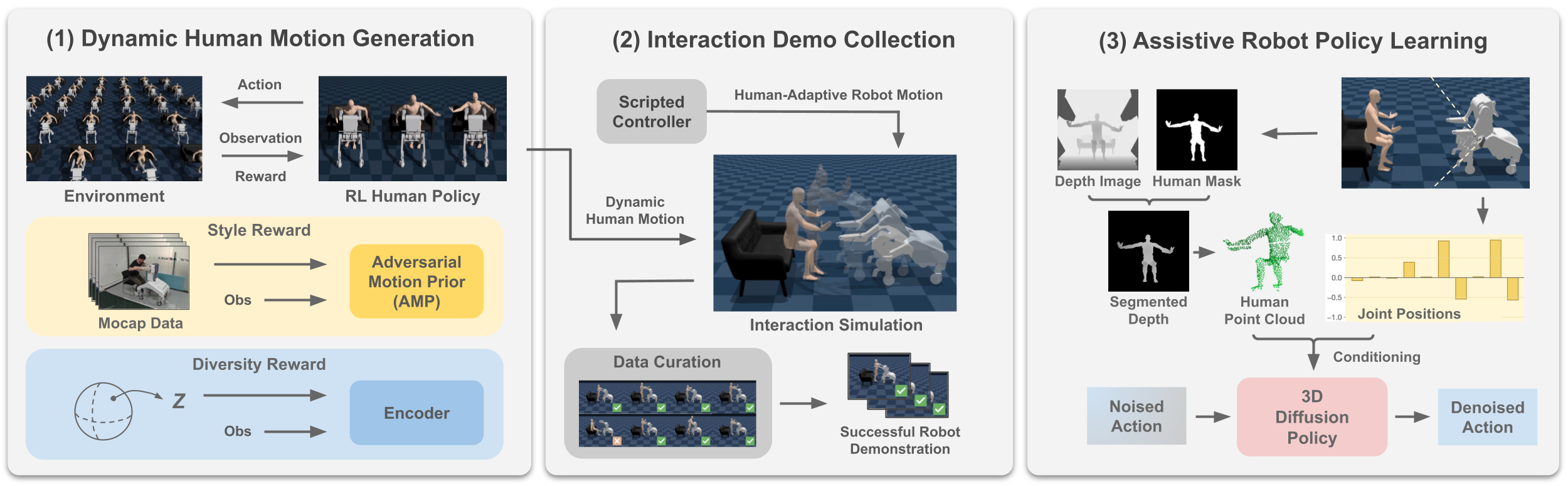

Method pipeline figure

Human Motion Generation


The physics-based human policy produces motions that are both realistic and diverse during physical interaction with the robot. We ablate its two ingredients — AMP and latent conditioning.


The policy trained with AMP produces realistic motions following the small set of motion capture data.


With AMP: natural, whole-body coordinated motion.

Without AMP: unnatural motion.

The human policy is conditioned on a latent variable, sampled once per episode from a normal distribution, which generates diverse yet temporally consistent motions.


Latent 1: one natural way of standing up.

Latent 2: a different, equally natural style.


Interaction Data Collection in Simulation


We collect robot demonstrations with a human-adaptive scripted controller under the active human policy, then filter successful interaction rollouts as demonstration data for robot policy learning.


Sit-to-
Stand
Success
Success
Success
Success
Failure
Success
Success
Success
Lift-and-
Transfer
Success
Success
Success
Success
Success
Success
Success
Failure
Filtering successful rollouts into saved robot demonstrations

Robot Policy Evaluation


Performance Across Human Body Scales

We evaluate whether the learned robot policy can assist humans with different body scales. The successful rollouts below show the same mixed-capability-trained robot policy operating across smaller and nominal human body scales on both assistive tasks.

Human body scale: 0.88

Sit-to-Stand
Lift-and-Transfer

Human body scale: 1.0

Sit-to-Stand
Lift-and-Transfer

Qualitative Comparison: Training Robot Policy with Mixed vs. Single Human Capability

Human capability means the human torque limit in simulation. Here we compare robot policies trained with different human capability distributions: one uses mixed capabilities, with both 1.0x and 0.25x humans, while the others use a single human capability.

In each paired rollout, the human and robot placement, running human policy, human scale, and human capability are the same. The only difference is the robot policy.

The rollouts below show that training with mixed human capabilities improves robustness: compared with policies trained only with 1.0x- or 0.25x-capability humans, mixed-capability training better adapts to the evaluated interactions and produces successful assistance.

Trained with Mixed (1.0x / 0.25x) Human Capabilities (Ours)
Trained with Single (1.0x) Human Capability
Trained with Mixed (1.0x / 0.25x) Human Capabilities (Ours)
Trained with Single (0.25x) Human Capability

Verifying Robot Assistance Necessity

We verify that the learned human policy cannot complete Sit-to-Stand without sufficient robot assistance, i.e., it cannot stand independently. The rollouts compare full robot assistance with assistance terminated at lift start and mid-lift. In both early-termination cases, the human fails to complete standing, even when lifted off the seat.

Full robot assistance

Assistance terminated mid-lift

Assistance terminated at lift start

Real-World Results


With approximately 6.5 minutes of real-world demonstration data for fine-tuning, the simulation-trained policy performs preliminary Sit-to-Stand assistance on a physical bimanual mobile robot, using only onboard RGB-D sensing and proprioception.


Real-world Sit-to-Stand assistance (2x).

Limitations and Future Work

This work has several limitations that motivate future work. First, real-world evaluation remains limited to Sit-to-Stand with one able-bodied participant; future work should extend evaluation to diverse participants, including care recipients with mobility impairments. Second, the current system does not directly regulate assistive forces; incorporating force sensing and human feedback could help modulate support during lifting. Third, simulated humans still differ from real users and target patient populations. Additional motion-capture data, human video priors, and musculoskeletal modeling could reduce this gap and improve the reliability of sim-to-real deployment.